
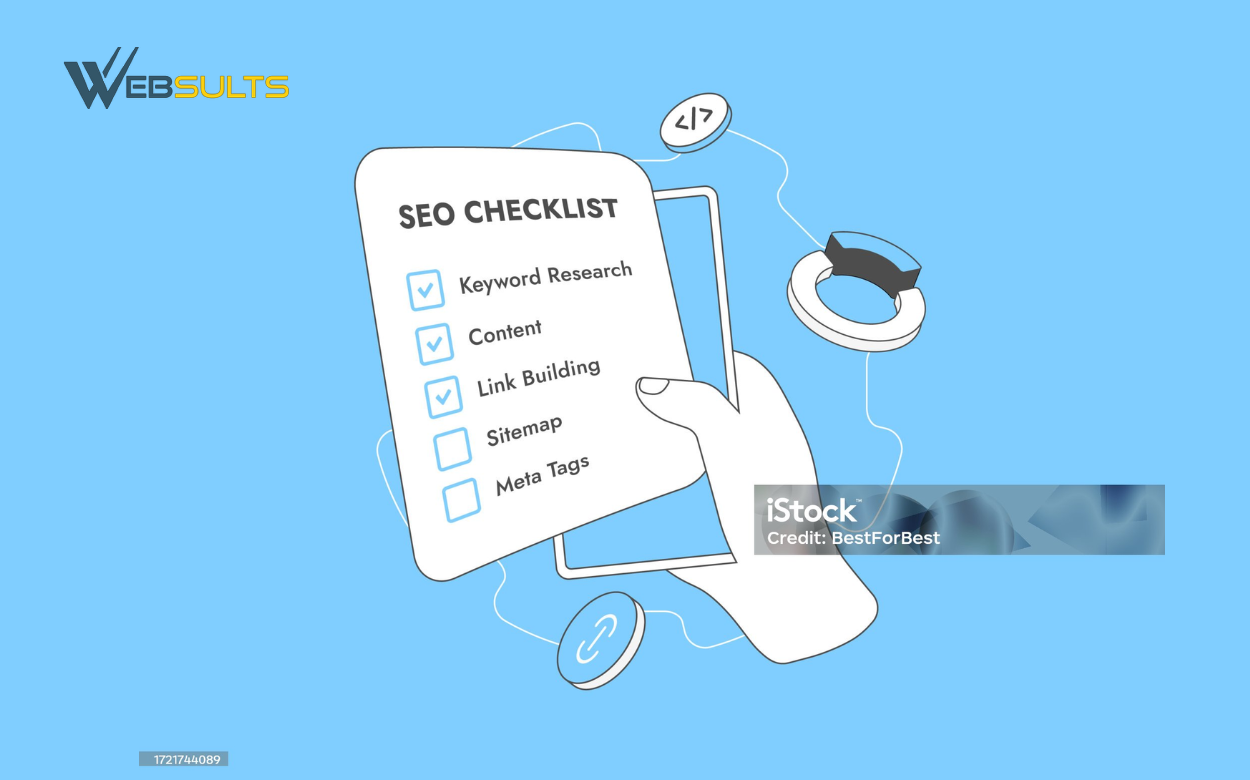
Launching a new website should be a growth moment for your business.
But we’ve seen it too often—companies invest time, money, and effort into a new site… only to see little to no traffic after launch.
It’s not because the site isn’t good. It’s because the SEO groundwork wasn’t fully in place.
At Websults, we’ve launched and rebuilt hundreds of websites across different industries. The difference between sites that perform and those that don’t usually comes down to one thing: how well the SEO foundation is handled before launch.
This is the checklist we use internally—expanded with the details most businesses miss.
Start with the Basics: Metadata & Page Structure
Every page on your website should clearly communicate what it’s about—both to users and search engines.
That starts with:
- A unique SEO title (not duplicated across pages)
- A meta description that explains value—not just keywords
- One clear H1 that matches search intent
- Supporting H2s and H3s that break content into logical sections
What most people get wrong:
They either reuse titles across pages or write vague headings like “Services” or “Welcome.”
What works better:
Be specific and intentional.
Instead of:
- “Services”
Use:
- “HVAC Repair Services in Tampa, FL”
This clarity helps Google match your page to searches—and helps users immediately understand they’re in the right place.
Keyword Optimization (Done Naturally)
Keywords still matter—but the way you use them has changed.
Instead of forcing repetition, your goal is to reinforce the topic naturally throughout the page.
Your primary keyword should appear in:
- SEO title
- Meta description
- H1
- First 100 words
- At least one H2
- Image alt text (when relevant)
But here’s the key:
Don’t write for keywords—write for clarity.
Google now understands context. If your page clearly explains a topic, you’ll naturally rank for variations of that keyword.
For example, a page about “AC repair in Tampa” should also naturally include:
- air conditioning repair
- AC service
- HVAC repair Tampa
You’re building topical relevance—not just repeating one phrase.
Clean URLs + Internal Linking Strategy
This is where a lot of websites quietly lose ranking potential.
Clean URLs
Your URLs should be:
- Short
- Descriptive
- Keyword-aligned
Example:
- ✔ /tampa-ac-repair/
- ✘ /services-page-1?id=874
Clean URLs improve both user trust and search engine understanding.
Internal Linking (This Is Bigger Than You Think)
Most websites treat internal linking as an afterthought—but it’s one of the most powerful SEO tools you have.
Each page should link to:
- Related services
- Relevant blog content
- Supporting pages
This helps:
- Google understand your site structure
- Pass authority between pages
- Guide users deeper into your website
For example:
A “Web Design” page should naturally link to:
- SEO services
- Portfolio / case studies
- Blog content about redesigns
Need help structuring your site the right way?
A lot of SEO issues come from poor structure. -not just content.
We help businesses fix this before it becomes a ranking problem.
👉 https://websults.com/contact/
Technical SEO: The Foundation Behind Everything
You won’t see this—but Google does.
Before launch, confirm:
- No important pages are accidentally set to noindex
- Your XML sitemap is generated and submitted
- Your robots.txt isn’t blocking key pages
- Canonical tags are properly set (to avoid duplicates)
- Your site loads fast—especially on mobile
- The site is fully responsive
Why this matters:
Even great content won’t rank if search engines can’t properly crawl or trust your site.
Common mistake we see:
Developers leave staging settings (like noindex) turned on when the site goes live.
That alone can completely block your site from appearing in search.
Image Optimization (Often Ignored, Always Important)
Images are one of the easiest places to improve performance—and one of the most overlooked.
Before launch:
- Compress large images (this directly affects speed)
- Rename files to match content
- ✔ tampa-roof-repair.jpg
- ✘ IMG_2045.jpg
- Add descriptive alt text
Why this matters:
- Faster sites rank better
- Alt text helps with accessibility and SEO
- You can show up in Google Image search
Tracking & Analytics Setup (Do This Before Launch)
If you don’t set this up, you’re guessing after launch.
At minimum:
- Google Analytics (GA4) → traffic + behavior
- Google Search Console → rankings + indexing
- Google Tag Manager → flexible tracking setup
What this allows you to see:
- Which pages get traffic
- What keywords you’re ranking for
- Where users drop off
- What’s actually converting
Without this data, you can’t improve your SEO—you’re just reacting.
Local SEO (For Service-Based Businesses)
If your business depends on local customers, this is one of the highest-impact areas.
Make sure you:
- Fully optimize your Google Business Profile
- Keep your NAP (Name, Address, Phone) consistent across all pages
- Use location keywords naturally in content
- Add a map embed on your contact page
Why this matters:
Local SEO is what drives:
- Map rankings
- “Near me” searches
- High-intent leads
This is where people are ready to take action—not just browse.
Content Quality & User Experience
Google is paying more attention to how users interact with your site.
Before launch, review your pages:
- Does the content answer real questions?
- Is it easy to scan (not long blocks of text)?
- Are the next steps clear (calls-to-action)?
Simple improvements that make a difference:
- Use bullet points
- Break up paragraphs
- Add clear section headings
- Make buttons obvious and easy to find
If users stay longer and engage, your rankings will improve over time.
Final Pre-Launch Checklist
This is where you catch the small issues that cause big problems later.
Before going live:
- Test all forms (contact, quote, etc.)
- Check for broken links
- Set up redirects (especially for redesigned sites)
- Run page speed tests
- Double-check indexing settings
Reality:
Most post-launch issues come from skipping this step.
SEO Is Not a One-Time Task
This is probably the biggest misconception.
Launching your site is just the beginning.
To actually grow, you need:
- Ongoing content (blogs, service pages)
- Link building
- Regular technical audits
- Continuous optimization
The websites that rank long-term are the ones that treat SEO as an ongoing process—not a one-time task.
Work With a Team That Builds for Long-Term Growth
At Websults, we don’t just launch websites—we build systems that support long-term visibility, traffic, and leads.
We focus on:
- Strong technical foundations
- Clear content strategy
- Scalable SEO growth
If you’re launching a new site – or your current one isn’t performing the way it should – it’s worth fixing the foundation now instead of chasing rankings later. https://websults.com/contact/